Showing posts with label career. Show all posts

Wednesday, March 29, 2023

A quick summary of the 7 habits of highly effective people.


A QUICK SUMMARY OF THE 7 HABITS OF HIGHLY EFFECTIVE PEOPLE

ARTICLE by Elle McFarlane


During his 25 years of working with successful individuals in business, universities, and relationship settings, Stephen Covey discovered that high-achievers were often plagued with a sense of emptiness. In an attempt to understand why, he read several self-improvement, self-help, and popular psychology books written over the past 200 years. It was here that he noticed a stark historical contrast between two types of success. 

Before the First World War, success was attributed to ethics of character. This included characteristics such as humility, fidelity, integrity, courage, and justice. However, after the war, there was a shift to what Covey refers to as the “Personality Ethic.” Here, success was attributed as a function of personality, public image, behaviors, and skills. Yet, these were just shallow, quick successes, overlooking the deeper principles of life.

Covey argues it’s your character that needs to be cultivated to achieve sustainable success, not your personality. What we are says far more than what we say or do. The “Character Ethic” is based upon a series of principles. Covey claims that these principles are self-evident and endure in most religious, social, and ethical systems. They have universal application. When you value the correct principles, you see reality as it truly is. This is the foundation of his bestselling book, The 7 Habits of Highly Effective People.


Covey’s seven habits are composed of the primary principles of character upon which happiness and success are based. The 7 Habits of Highly Effective People puts forward a principle-centered approach to both personal and interpersonal effectiveness. Rather than focusing on altering the outward manifestations of your behavior and attitudes, it aims to adapt your inner core, character, and motives.

The seven habits in this book will help you move from a state of dependence, to independence, and finally to interdependence. While society and most of the self-help books on the market champion independence as the highest achievement, Covey argues that it’s interdependence that yields the greatest results. 

Interdependence is a more mature, advanced concept. It precludes the knowledge that you are an independent being, but that working with others will produce greater results than working on your own. To attain this level of interdependence, you must cultivate each of the seven habits laid out in the book. The seven habits are as follows:

  1. Be proactive
  2. Begin with the end in mind
  3. Put first things first
  4. Think win/win
  5. Seek to understand first, before making yourself understood
  6. Learn to synergize
  7. Sharpen the saw

This 7 Habits of Highly Effective People book summary will look at each of these habits and show you how to put them into action to become more successful in whatever you want to achieve.

Habit 1: Be Proactive
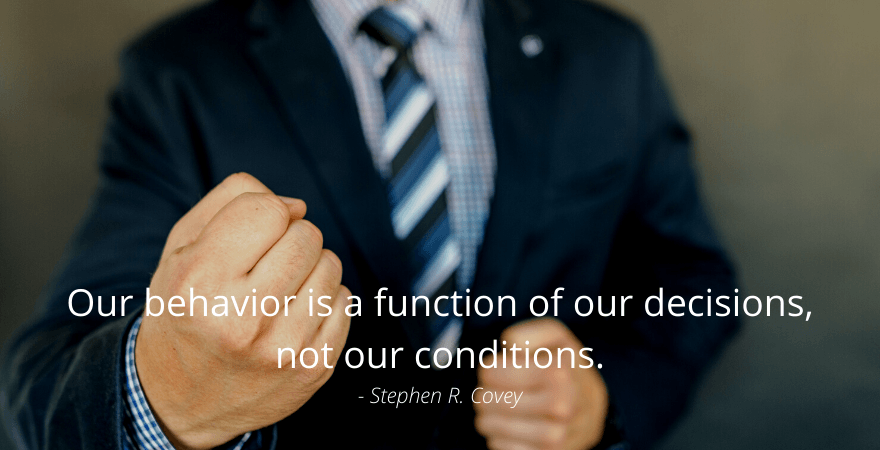
The first and most fundamental habit of an effective person is to be proactive. More than just taking the initiative, being proactive means taking responsibility for your life. Consequently, you don’t blame your behavior on external factors such as circumstances, but own it as part of a conscious choice based on your values. Where reactive people are driven by feelings, proactive people are driven by values.

While external factors have the ability to cause pain, your inner character doesn’t need to be damaged. What matters most is how you respond to these experiences. Proactive individuals focus their efforts on the things they can change, whereas reactive people focus their efforts on the areas of their lives in which they have no control. They amass negative energy by blaming external factors for their feelings of victimization. This, in turn, empowers other forces to perpetually control them.

The clearest manifestation of proactivity can be seen in your ability to stick to the commitments you make to yourself and to others. This includes a commitment to self-improvement and, by extension, personal growth. By setting small goals and sticking to them, you gradually increase your integrity, which increases your ability to take responsibility for your life. Covey suggests undertaking a 30-day proactivity test in which you make a series of small commitments and stick to them. Observe how this changes your sense of self.

Habit 2: Begin With the End in Mind

To better understand this habit, Covey invites you to imagine your funeral. He asks you to think how you would like your loved ones to remember you, what you would like them to acknowledge as your achievements, and to consider what a difference you made in their lives. Engaging in this thought experiment helps you identify some of your key values that should underpin your behavior. 

Accordingly, each day of your life should contribute to the vision you have for your life as a whole. Knowing what is important to you means you can live your life in service of what matters most. Habit two involves identifying old scripts that are taking you away from what matters most, and writing new ones that are congruent with your deepest values. This means that, when challenges arise, you can meet them proactively and with integrity, as your values are clear.

Covey states that the most effective way to begin with the end in mind is to create a personal mission statement. It should focus on the following:

  • What you want to be (character)
  • What you want to do (contributions and achievements)
  • The values upon which both of these things are based

In time, your mission statement will become your personal constitution. It becomes the basis from which you make every decision in your life. By making principles the center of your life, you create a solid foundation from which to flourish. This is similar to the philosophy Ray Dalio presents in his book, Principles. As principles aren’t contingent on external factors, they don’t waver. They give you something to hold on to when times get tough. With a principle-led life, you can adopt a clearer, more objective worldview.

Habit 3: Put First Things First

To begin this chapter, Covey asks you to answer the following questions:

  1. What one thing could you do regularly, that you aren’t currently doing, that would improve your personal life?
  2. Similarly, what one thing could you do to improve your business or professional life?

Whereas habit one encourages you to realize you are in charge of your own life, and habit two is based on the ability to visualize and to identify your key values, habit three is the implementation of these two habits. It focuses on the practice of effective self-management through independent will. By asking yourself the above questions, you become aware that you have the power to significantly change your life in the present.

Thus, having an independent will means you are capable of making decisions and acting on them. How frequently you use your independent will is dependent on your integrity. Your integrity is synonymous with how much you value yourself and how well you keep your commitments. Habit three concerns itself with prioritizing these commitments and putting the most important things first. This means cultivating the ability to say no to things that don’t match your guiding principles. To manage your time effectively in accordance with habit three, your actions must adhere to the following:

  1. They must be principle-centered.
  2. They must be conscience-directed, meaning that they give you the opportunity to organize your life in accordance with your core values.
  3. They define your key mission, which includes your values and long-term goals.
  4. They give balance to your life.
  5. They are organized weekly, with daily adaptations as needed.

The thread that ties all five of these points together is that the focus is on improving relationships and results, not on maximizing your time. This shares sentiments with Tim Ferris who, in The 4-Hour Work Week, argues that time management is a deeply flawed concept.

Habit 4: Think Win/Win

Covey argues that win/win isn’t a technique, it’s a philosophy of human interaction. It’s a frame of mind that seeks out a mutual benefit for all concerned. This means that all agreements or solutions are mutually beneficial, and all parties feel satisfied with the outcome. To embody this mindset, life must be seen as a cooperative, not a competition. Consequently, anything less than a win/win outcome goes against the pursuit of interdependence, which is the most efficient state to be operating within.

Therefore, to adopt a win/win mindset, you must cultivate the habit of interpersonal leadership. This involves exercising each of the following traits when interacting with others:

  • Self-awareness
  • Imagination
  • Conscience
  • Independent will

To be an effective win/win leader, Covey argues that you must embrace five independent dimensions:

  1. Character: This is the foundation upon which a win/win mentality is created, and it means acting with integrity, maturity, and an “abundance mentality” (i.e., there is plenty of everything for everyone, one person’s success doesn’t threaten your success).
  2. Relationships: Trust is essential to achieving win/win agreements. You must nourish your relationships to maintain a high level of trust.
  3. Agreements: This means that the parties involved must agree on the desired results, guidelines, resources, accountability, and the consequences.
  4. Win/win performance agreements and supportive systems: Creating a standardized, agreed-upon set of desired results to measure performance within a system that can support a win/win mindset.
  5. Processes: All processes must allow for win/win solutions to arise.

Habit 5: Seek First to Understand, Then to Be Understood

If you want to improve your interpersonal relations, Covey argues that you must endeavor to understand a situation before attempting to make yourself understood. The ability to communicate clearly is essential for your overall effectiveness, as it’s the most important skill you can train. While you spend years learning to read, write, and speak, Covey states that little focus is given to training the skill of listening.

If your principles are solid, you’ll naturally want to engage and listen to people without making them feel manipulated. Consequently, it’s through your character that you transmit and communicate what type of a person you are. Through it, people will come to instinctively trust and open up to you. While most people listen with the intent of replying, the proficient listener will listen with the intent to understand. This is known as the skill of empathic listening.

An empathic listener can get into the frame of reference of the person speaking. By doing so, they see the world as they do and feel things the way they feel. Empathic listening, therefore, allows you to get a clearer picture of reality. When you begin to listen to people with the intent of understanding them, you’ll be astounded at how quickly they will open up.

Once you think you’ve understood the situation, the next step is to make yourself understood. This requires courage. By using what you’ve learned from empathic listening, you can communicate your ideas in accordance with your listener’s paradigms and concerns. This increases the credibility of your ideas, as you will be speaking in the same language as your audience.

Habit 6: Synergize

When synergy is operating at its fullest, it incorporates the desire to reach win/win agreements with empathic communication. It’s the essence of principle-centered leadership. It unifies and unleashes great power from people, as it’s based on the tenant that the whole is greater than the sum of its parts. The real challenge is to apply principles of synergetic creative cooperation into your social interactions. Covey argues that such instances of synergetic interpersonal group collaboration are often neglected but should be part of your daily life.

At its core, synergy is a creative process that requires vulnerability, openness, and communication. It means balancing the mental, emotional, and psychological differences between a group of people and, in doing so, creating new paradigms of thought between the group members. This is where creativity is maximized. Synergy is effectiveness as an interdependent reality. This involves teamwork, team building, and the creation of unity with other human beings.

Habit 7: Sharpen the Saw

This seventh habit is all about enhancing yourself through the four dimensions of renewal:

  1. Physical: Exercise, nutrition, and stress management. This means caring for your physical body, eating right, getting enough sleep, and exercising regularly.
  2. Social/emotional: Service, empathy, synergy, and intrinsic security. This provides you with a feeling of security and meaning.
  3. Spiritual: Value clarification and commitment, study, and meditation. In focusing on this area of your life, you get closer to your center and your inner value system.
  4. Mental: Reading, visualizing, planning, and writing. To continually educate yourself means expanding your mind. This is essential for effectiveness.

To “sharpen the saw” means to express and exercise all four of these motivations regularly and consistently. This is the most important investment you can make in your life, as you are the instrument of your performance. It’s essential to tend to each area with balance, as to overindulge in one area means to neglect another. 

However, a positive effect of sharpening your saw in one dimension is that it has a knock-on positive effect in another, due to them being interrelated. For instance, by focusing on your physical health, you inadvertently improve your mental health, too. This, in turn, creates an upward spiral of growth and change that helps you to become increasingly self-aware. Moving up the spiral means you must learn, commit, and do increasingly more as you move upwards and progressively become a more efficient individual.

You can buy The 7 Habits of Effective People by Stephen R. Covey on Amazon

.


Need a Career Coach?

 Click here to get a free Zoom session with Suhair.          


Friday, February 10, 2023

15 critical secrets of mentally tough people


15 critical secrets of mentally tough people

Let’s get one thing straight: Mental strength is a process and not an innate quality.

In our everyday lives, our mental and emotional rigor are tested by people we socialize with. It is our reactions to those situations that define who we are as people.

It’s natural to want the best things for ourselves: better friends, a better job, better pay. On the other hand, these things aren’t easy to achieve especially when you feel like you can’t change your life. Breaking the norm and changing your lifestyle to achieve greater things requires qualities that most strong people have.

Instead of looking down at obstacles, they see these as challenges they could use to build up character and skill. Negativity is non-existent because bad forces in life turn out to be potential learning opportunities.

This is just one of the habits strong individuals routinely exercise to keep their head above water.

Below are more personality traits you (and any other strong person) could grow into:

1) They are optimistic

The world is a terrible place, as most news outlets would report. Nonstop famine, war, sadness, and crime are reported from all around the globe.

This barrage of negative vibes makes it hard to have a positive outlook on life, but strong people know better than to let bad events affect them.

The world may be a bad place, but strong-willed individuals understand that getting caught up in these things won’t magically transform all humans into peace-loving creatures.

Instead of trying to change things they can’t control, strong people shift their focus on their individual pursuits instead of worrying about the world.

The good news is, studies show that optimism is about 25 percent inheritable, and then there are other factors that affect our positivity.

“Anyone can learn to be optimistic — the trick is to find purpose in work and life,” says Leah Weiss, Ph.D, a Stanford professor specializing in mindfulness. “When we work with purpose or live with purpose, we feel more fulfilled and better equipped to see the glass ‘half full.’”

2) They don’t need validation

There’s a saying that goes, “If you make enemies in your life that’s when you know you’re doing something right.” People are made differently, which makes it pretty inevitable to get into disagreements with people.

The fact is, you can’t please everyone, so why even bother fitting in every single social circle in the first place?

Social anxiety is one thing, but trying your hardest to get praise and admiration from everyone around you is another. Holding on to these emotions leads to stress and can have dire impacts on your general well-being.

According to Psychology Today, you don’t need validation if you have good self-esteem.

3) They understand the value of rest

Nowadays, we associate all-nighters with success because our culture has changed the way we look at productivity, where more hours automatically means a job well done..

Still, our bodies haven’t changed and we still need enough work to function throughout the day.

Multiple studies have proved time and time again that sleep-deprived individuals are more likely to give in to impulses, have less focus, and make other questionable or risky choices.

People who don’t get enough sleep are literally less mentally tough than people who enjoyed an 8-hour shut eye.

4) They don’t rely on huge amounts of caffeine for energy

Too much caffeine in your system automatically releases adrenaline into your body. This causes you to go into a state of fight-or-flight, in which you make a decision based on speed and quickness rather than rationality.

Yes, caffeine can give you cognitive benefits, but too much caffeine may ruin your concentration.

At some point, your body will hit a wall, and you’ll start to experience irritability.

According to the Mayo Clinic, up to 400 milligrams of caffeine (4 cups of coffee) is a safe amount for most adults who want to avoid side effects.

5) They Don’t Need An Apology to Move Forward

A lot of people concern themselves with grudges; who did what, how they were hurt, what they deserve, and the pain that was caused them.

But this takes a lot of time and emotional turmoil, which brings you down and limits your happiness. It’s stress that you don’t need, stress which can bring you mental and physical consequences. So instead of waiting for an apology, just move forward.

6) They Keep Their Bodies Fit

Research suggests that physical stress can relieve mental stress.

Harvard Health Blog says that aerobic exercise is key for your head, just as it is for your heart:

“Regular aerobic exercise will bring remarkable changes to your body, your metabolism, your heart, and your spirits. It has a unique capacity to exhilarate and relax, to provide stimulation and calm, to counter depression and dissipate stress. It’s a common experience among endurance athletes and has been verified in clinical trials that have successfully used exercise to treat anxiety disorders and clinical depression. If athletes and patients can derive psychological benefits from exercise, so can you.”

According to Harvard Health, exercise works because it reduces levels of the body’s stress hormones, such as adrenaline and cortisol.

It also stimulates the production of endorphins, which are natural painkillers and mood elevators.


7) They Never Stop Anyone From Having Fun

Being the master of your own happiness means that you don’t care about the joy and experiences of others.

Those who are weak-minded spend too much time dwelling on whether others are experiencing better joys than them.

Research suggests that those who are motivated to please or impress others perform worse than those who set goals for themselves.

Those who have the mental toughness to think about themselves and make their own experiences the best they can be couldn’t care less about what other people are doing.

Jealousy and resentment can sap your own joys in life. Wasting your energies on these negative emotions pulls you down as well, so why do it at all?

8) And They Never Let Anyone Stop Them From Having Fun

Experience life the way you want to experience it. Live life to the fullest, and take advantage of every bit of joy and happiness you have.

Mentally tough people don’t let the thoughts and opinions of others define the way they experience situations; instead, they let themselves be the judge of how they feel and how they act.

Laurence Gonzales, author of SURVIVING SURVIVAL: The Art and Science of Resiliencein an article writes:

Julian Rotter, a professor of psychology at the University of Connecticut, developed the concept of what he calls “locus of control.” Some people, he says, view themselves as essentially in control of the good and bad things they experience — i.e., they have an internal locus of control.

No matter what people think, that will never change the reality of how you are.

9) They Let Themselves Fail

Some of us are terrified of failure. We don’t want to lose and don’t want to be laughed at, to the point that we can’t stand the act of participating at all.

But people who are mentally strong have no fear of failure. In fact, they embrace it: they understand that each failure is a lesson for them, adding value to their overall character.

10) And They Don’t Obsess Over Their Mistakes

With failure comes mistakes. We all make mistakes, but the way we approach mistakes defines our relationship with them.

For some of us, we are intrinsically terrified of mistakes and failure, and we refuse to even try, in the fear of doing something wrong.

But mentally tough people make mistakes, just like the rest of us do; the difference, however, is that they don’t let their mistakes define them. They learn from them and move on.

Journalist Hara Estroff Marano once wrote in a Psychology Today article “The Art of Resilience”:

“Resilience may be an art, the ultimate art of living…

At the heart of resilience is a belief in oneself–yet also a belief in something larger than oneself. Resilient people do not let adversity define them. They find resilience by moving towards a goal beyond themselves, transcending pain and grief by perceiving bad times as a temporary state of affairs.”

[If you’re looking for specific actions you can take to stay in the moment and live a happier life, check out our best-selling eBook on how to use Buddhist teachings for a mindful and happy life here.]

11) They Love Change

Adapting is the favorite thing to do of the mentally tough individual. Being afraid of change can limit what you can achieve in life, so instead of fearing it, they look for every opportunity to unravel it.

12) They Know When To Say No

When your boss asks you to do something, you might have this built-in feeling that you simply can’t say no.

But mentally tough people know that “no” is important. “No” is the affirmation that you care about your own time and space, and you know when to protect your personal wants and needs rather than letting themselves be taken advantage of. Secondly, they also know how to say “no” to vices.

According to an article in Entreprenuer.com, by saying no “they can make sure to complete their own work first and not overextend themselves.”

Sometimes, enough is enough.

13) They Get Rid Of Toxicity

Toxic people are anchors to our lives; their toxicity brings us down, and if we don’t watch out, they can turn us into toxic people as well. Mentally tough people have realized this, and do everything in their power to cut toxic people out.

They don’t allow their anger or frustration to build chaos within themselves and know how to separate the toxicity of others from their own true, healthy feelings.

In fact, according to an 80-year Harvard study, our closest relationships may impact our happiness significantly.

14) They Are Confident No Matter What

“Whether you think you can, or think you can’t—you’re right.” — Henry Ford

Confidence is something that comes and goes for some of us, depending on the day or the compliment we receive.

But mentally tough people create their own confidence, and it’s something that lives with. They also inspire confidence in others, making them better leaders and role models.

study at the University of Melbourne showed that confident people went on to earn higher wages and get promoted more quickly than others did.

15) And They Have High Emotional Intelligence

Emotional intelligence is one of the most important qualities of a mentally tough individual. Knowing how to understand and tolerate the actions and thoughts of others is key towards controlling your own emotions.

And the great thing about EQ is that it is something you can develop and learn. Unfortunately, not many people have strong EQ; it was found in a recent study that just 36% of people can accurately identify their own emotions while they are feeling them.

How mental toughness helped me

A big part of my focus at Hack Spirit is creating content that helps people develop mental toughness and become more resilient.

I do this because mental toughness is something I had to learn and practice over a number of years myself.

Like everyone, I’ve had times when I haven’t been resilient. Career setbacks, health issues and difficult relationships – these were things that I was tempted to put in the ‘too hard’ basket and let them derail my life.

However, I reached a point in my life when I realized I had to take responsibility for everything in my life and become mentally tougher.

Six years ago, I was a ridiculously average guy in my 20s who still lived at home. I worked in a warehouse lifting boxes by day, and lay on the sofa pitying myself by night. Life wasn’t working out as planned.

So I set about studying eastern philosophy and taking in the practical lessons that came from that. I’ve learned real, easy-to-action strategies that mean I’m now equipped to deal with whatever life throws at me.

Developing my mental toughness has allowed me to create one of the world’s leading blogs on practical psychology. Hack Spirit now has two million monthly readers and it’s growing bigger every month.

I wouldn’t be where I am today unless I took deliberate action to develop my mental toughness and become more resilient in the face of my challenges.

Introducing my book

If you want a practical, down-to-earth guide to boosting your mental toughness, check out my new eBook The Art of Resilience: A Practical Guide to Developing Mental Toughness.

Now, the value of mental toughness isn’t exactly a secret. However, mental toughness and resilience aren’t traits we’re simply born with – they have to be learned and developed.

And this eBook will show you exactly how to do just that.

In this eBook, I demonstrate the key traits of 20 of history’s toughest people, show you how to discover what your current level of resilience really is, and – most importantly – provide 10 easy-to-follow resilience-building exercises so that you can boost your own mental toughness.

If you possess the discipline to consistently practice these exercises and embrace responsibility for the events in your life (i.e. stomp out any ‘victim mentality’), I guarantee you will:

  • Develop unshakable confidence
  • ​Be mentally equipped to tackle and conquer any challenge
  • ​Become emotionally ‘bulletproof’ in times of crisis, allowing you to successfully navigate the fallout until you arrive in a better place
  • ​Have the calm confidence to take more chances and finally embrace life.

Need a Career Coach?

 Click here to get a free Zoom session with Suhair.

Thinking fast and slow by Daniel Kahneman

  Thinking Fast And Slow Summary By: Niklas Goeke Say what you will, they don’t hand out the Nobel prize for economics like it’s a slice of ...